MetLife Stadium New York — 2026 World Cup Final Venue and Its Solar Ring
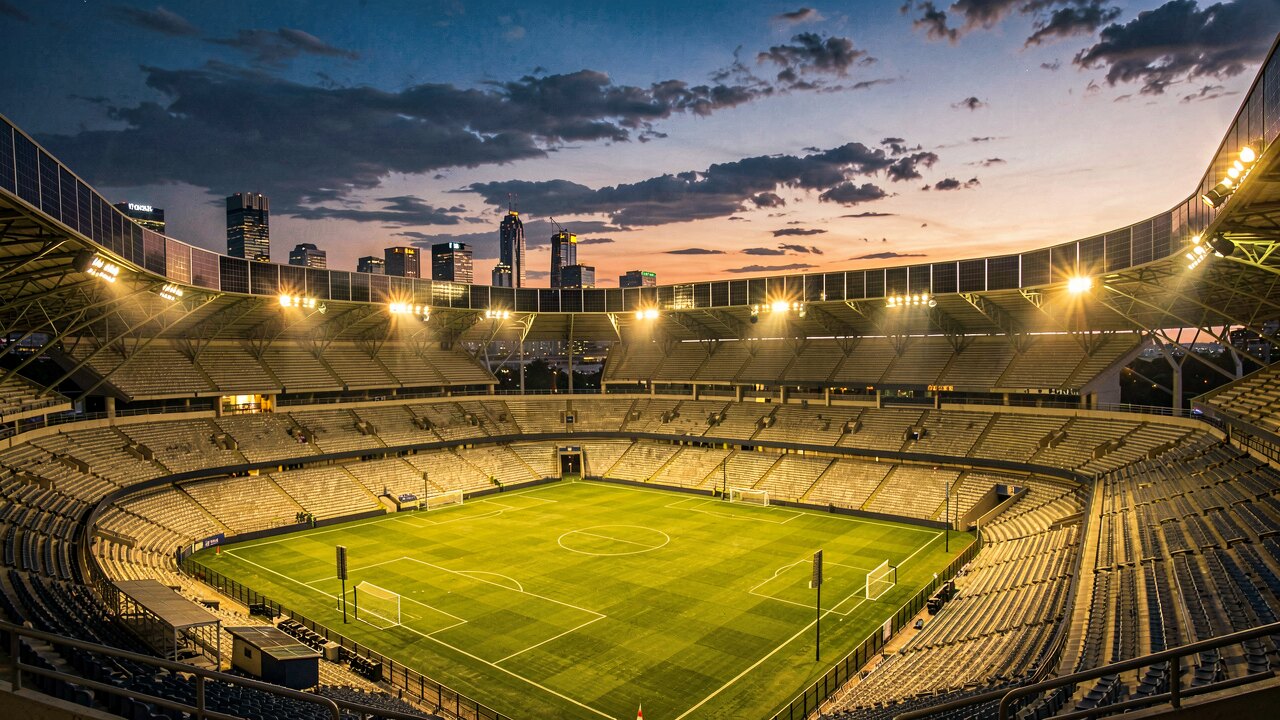
On July 19, 2026, the final of the FIFA 2026 Football World Cup will be played at MetLife Stadium in East Rutherford, New Jersey. Around 82,500 spectators will be seated in one of the most expensive arenas in the world — open air, without a roof over the pitch. While the world watches the ball, floodlights, video walls, catering and climate systems run at full load in the background. What that means, and what the stadium's so-called Solar Ring contributes, we examine closely here.
Architecture & Capacity
MetLife Stadium opened on April 10, 2010 — as the successor to Giants Stadium, which had stood on the same New Jersey Meadowlands site since 1976. Construction cost approximately 1.6 billion US dollars, with the two tenants — the New York Giants and the New York Jets — splitting costs equally without public funding, which is unusual for a stadium of this size.
The stadium is deliberately designed as an open-air arena: no closable roof, no complex indoor climate system — but weather dependence, which is acceptable for the World Cup Final in July in New Jersey. For the 2026 World Cup, the arena carries the FIFA tournament name "New York New Jersey Stadium" (sponsor names are not permitted during the tournament). The capacity is slightly adjusted for the World Cup: approximately 1,740 corner seats are removed to accommodate a FIFA-compliant pitch.
How Much Power the Stadium Uses
MetLife Stadium is an open-air stadium — that significantly shapes its energy profile. What accounts for a large portion of annual consumption in enclosed arenas like NRG Stadium in Houston — cooling the interior — largely falls away here. The dominant loads are instead:
- LED floodlights: The switch from halogen metal halide lamps to LED has drastically reduced lighting consumption. According to operator figures, the LED system saves around 1,045,000 kWh per year compared with the old lighting.
- Video walls & scoreboards: The large ring scoreboards and end-zone screens draw considerable power on matchdays.
- Catering: Around 82,500 spectators means large kitchens, refrigeration systems and serving stations on multiple levels.
- Building services & infrastructure: Elevators, pumps, security systems, communications technology.
Concrete, publicly verified annual consumption figures for MetLife Stadium are not available. Industry surveys for US professional football stadiums of this size cite ranges of 7 to 15 million kWh per year. In this segment, a single matchday typically draws 50,000 to 65,000 kWh over approximately ten hours — peak demand during the game up to 10 MW. According to the operator, MetLife uses 30 percent less operating energy than Giants Stadium despite being double the size — primarily through LED and a sophisticated lighting control system that additionally saves approximately 130,000 kWh annually.
The open-air character makes MetLife more energy-lean than comparable enclosed or air-conditioned arenas — but it also makes the stadium dependent on the weather: in extreme heat or cold, demand for heating or cooling of hospitality and infrastructure areas increases noticeably.
Renewable Energy & Sustainability
The most conspicuous sustainability feature of MetLife Stadium is its so-called Solar Ring: a continuous row of approximately 1,350 solar modules directly at the roof edge of the arena. According to operator figures, the installation has a capacity of approximately 350 kilowatts. MetLife is therefore regarded as the only US sports stadium to carry a roof-integrated photovoltaic installation in this encircling form.
According to operator figures, the 350 kW installation generates enough electricity to cover the stadium's daily basic electricity needs — surplus power is fed back into the grid. For comparison: the annual output corresponds, according to the operator's calculation, to saving the equivalent CO₂ emissions of approximately 53 passenger cars per year. Relative to the total load of a matchday (approximately 50,000–65,000 kWh), this is a modest but symbolically and technically relevant contribution.
Further sustainability measures at the stadium include:
- LED floodlights with programmable control system (approximately 1,175,000 kWh/year savings according to operator)
- Reduction of solid waste by almost a quarter compared with the predecessor stadium — despite double the size
- Operating energy 30% below predecessor (Giants Stadium), per operator statement
MetLife does not hold a LEED certification (as Mercedes-Benz Stadium in Atlanta does). The venue positions itself through concrete savings metrics rather than an overall certificate.
Stromfee Assessment
MetLife Stadium shows a pattern familiar from industry: a large consumer that measurably reduces its footprint through LED modernisation and own generation — without talking away the base load. The Solar Ring self-generates at best a small fraction of matchday demand. The real lever lies in efficiency: 30% less consumption at double the floor area is a real result that counts.
The same logic — reduce consumption, maximise own generation, optimise the remainder — applies to every PV installation and every storage system in Germany. Anyone who wants to know what volatile electricity prices and the Solar Peak Law (§51 EEG) mean concretely for their own installation can calculate that with our freely accessible tools in a few minutes.
Transparency & Sources: Opening date, construction cost and capacity from Wikipedia/StadiumDB (as of June 2026). World Cup Final date July 19, 2026 per FIFA match schedule (Al Jazeera/FIFA, February 2024). Solar Ring figures (1,350 modules, ~350 kW, operating energy −30%) from operator MetLife Stadium / NRG Energy. Annual consumption ranges 7–15 million kWh and matchday figures from US professional stadium industry surveys (electricchoice.com). No matchday measurement of World Cup matches. The images shown are AI illustrations (FLUX·2), not photographs of the real stadium.
Have your installation assessed?
Independent grid & drive analysis, direct marketing and metering concept — by HR Energiemanagement.
Get in touch →