AT&T Stadium Dallas: Power, Roof and the 2026 FIFA World Cup Semifinal
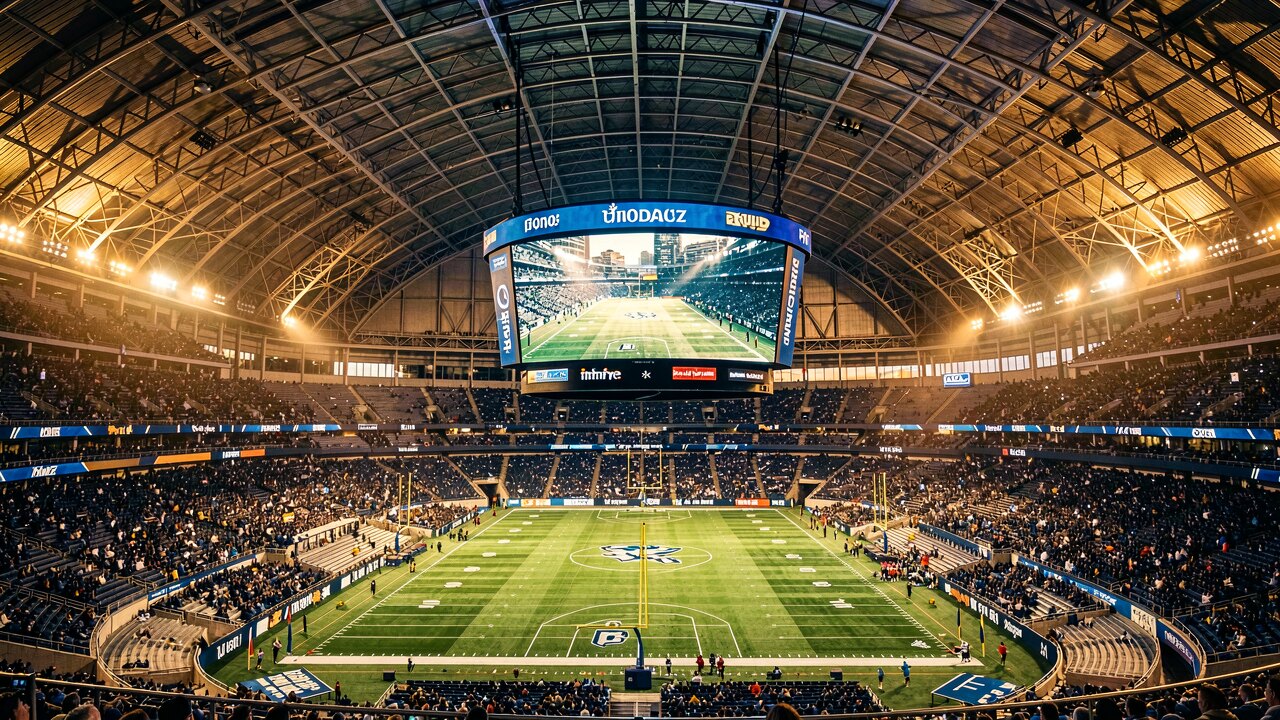
No 2026 World Cup venue hosts more matches than AT&T Stadium in Arlington, Texas: nine games from the group stage through to the semifinal on July 14, 2026 — more than any other of the 16 arenas. Under its FIFA tournament name "Dallas Stadium", the home of the Dallas Cowboys is not only the most-used stadium of the tournament but also one of its most energy-intensive venues: retractable mega-roof, air-conditioned interior, one of the NFL's largest LED video walls — all combined, on a matchday, these draw a load that could supply a small industrial site.
Architecture & Capacity
The stadium opened on May 27, 2009 and reportedly cost around 1.3 billion US dollars (approximately 2 billion USD in today's value). The architect was the Texas firm HKS, Inc., led by Bryan Trubey, who envisioned the building as a "near-urban structure" — less a pure sports venue, more a public space. Structural engineering was handled by Walter P. Moore Engineers.
The most distinctive feature is the retractable roof, consisting of two steel arches approximately 91 meters tall that span the full length of the building. Two roof panels made of partially translucent fabric membrane can be opened or closed by a rack-and-pinion drive in approximately twelve minutes. At each end zone are full-height retractable glass facades (manufactured by Haley-Greer, Dallas), which can open the interior to outside air or seal it completely. The building is considered one of the largest column-free enclosed spaces in the world.
The permanent NFL capacity is approximately 80,000 seats; standing room allows for over 100,000 spectators. For the 2026 World Cup, FIFA configures the arena for a tournament capacity of 70,122 seats — due to media, operations and security areas required by FIFA standards.
How Much Power the Stadium Uses
No publicly verified annual consumption figures are available for AT&T Stadium. As a reference: industry surveys of US professional stadiums of this size typically cite 7 to 15 million kWh per year — equivalent to the annual consumption of approximately 2,000 to 4,000 average households. On a single matchday, industry figures suggest around 50,000 to 65,000 kWh, with peak demand during a game reaching up to 10 megawatts.
AT&T Stadium has a particularly energy-intensive profile that stems from three structural characteristics:
- Air conditioning (HVAC): Because the roof can be fully closed — and in the Texas summer heat it regularly is — the building must be actively cooled. In Texas July, when temperatures can exceed 40 °C, this is by far the single largest consumer. Comparable enclosed arenas cite figures of 10 to 20 MWh for cooling alone on a matchday.
- LED video wall: A massive double-sided video wall hangs centrally over the playing field inside the stadium. The Mitsubishi installation measured approximately 53 by 22 meters (175 × 72 feet) at the 2009 opening — making it the world's largest HD video display at the time. It has since been upgraded to LED technology, but still draws significant power.
- Floodlights: FIFA matches require minimum illumination levels that are higher for broadcast formats than in regular NFL operation. The stadium has replaced older lighting systems with LED, which has significantly reduced the lighting share of total energy consumption.
According to manufacturer specifications, the regenerative drives of the roof mechanism feed back a portion of the energy into the internal grid during the closing process — a small but technically interesting detail.
Renewable Energy & Sustainability
Rooftop photovoltaics are not documented at AT&T Stadium. The partially translucent fabric membrane of the roof is not a suitable substrate for PV modules; the building therefore generates no significant solar power of its own based on current information.
What the stadium does operate is an energy management system for controlling lighting, air conditioning and overall load, along with a complete conversion to LED lighting throughout the building. Natural daylight through the semi-transparent roof and the glass end zones reduces the need for artificial light during the day. Recycling programs and water-saving fixtures round out the sustainability program — compared with solar-certified arenas such as Mercedes-Benz Stadium Atlanta (LEED Platinum, over 1,600 MWh solar output per year) or Lumen Field Seattle (3,750 modules), AT&T Stadium is relatively undocumented in this area.
No external certification (such as LEED) is publicly known for AT&T Stadium.
Stromfee Assessment
AT&T Stadium is a prime example of a large consumer running air conditioning, display loads and floodlights simultaneously — with a load profile that surges sharply in the Texas summer and reaches industrial-park levels for several hours. Exactly these kinds of consumers benefit from flexible energy procurement: anyone who knows when spot prices fall can proactively hold cooling and storage capacity. For your own installation — whether PV, CHP or battery storage — our free calculator shows what volatile electricity exchange prices and the Solar Peak Law (§51 EEG) mean in concrete terms.
Transparency & Sources: Stadium data from Wikipedia/HKS/Walter P. Moore (as of 2026). World Cup schedule and tournament capacity from FIFA.com and dallasfwc26.com (verified June 2026). Architectural details from Uni-Systems Engineering and Evans Engineering. Consumption figures (kWh/year, matchday, peak load) are industry ranges from US stadium surveys (electricchoice.com, SEIA) — not measured AT&T Stadium individual values. Sustainability information from tfcstadiums.com. The hero image is an AI illustration (FLUX·2) and not a photograph of the real stadium.
Have your installation assessed?
Independent grid & drive analysis, direct marketing and metering concept — by HR Energiemanagement.
Get in touch →