Gillette Stadium Boston: Lighthouse, Solar and Fuel Cells at the 2026 World Cup
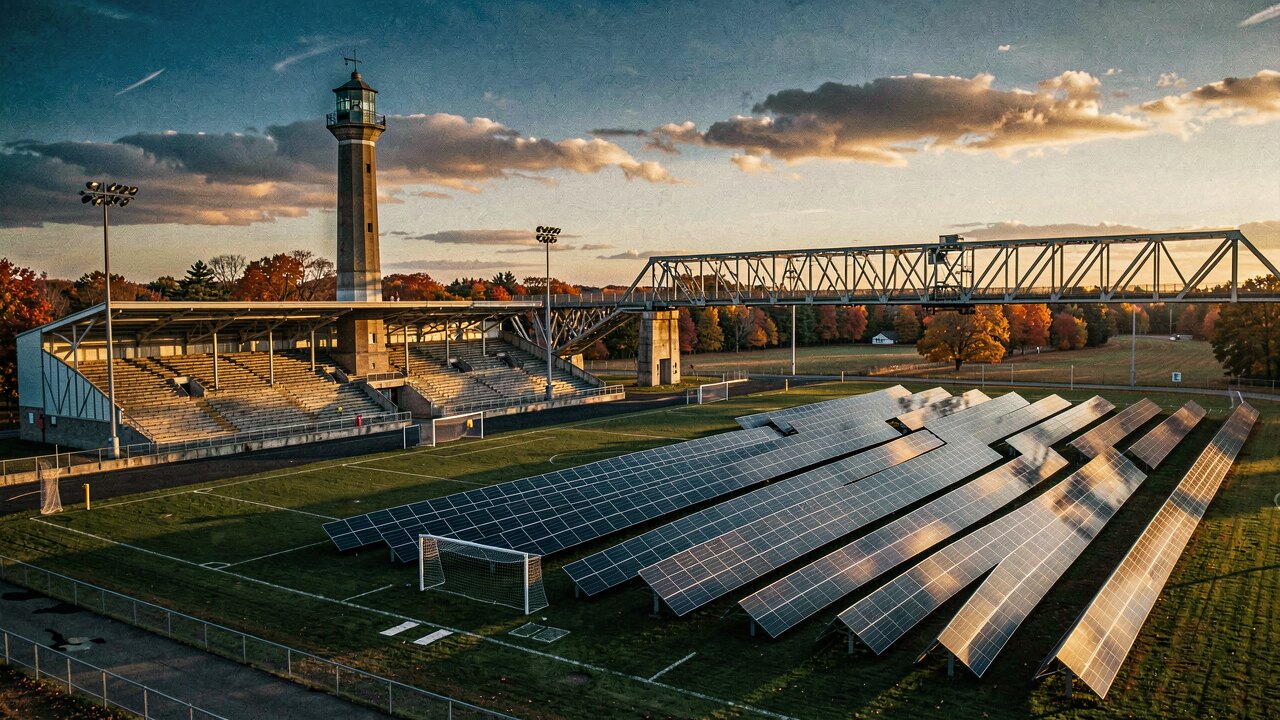
Foxborough, Massachusetts, lies 45 kilometres south of Boston — and is nonetheless the World Cup 2026 host as the "Boston Stadium" for seven matches up to and including the quarterfinal on July 9, 2026. Gillette Stadium is an open NFL stadium with no roof, built for cold New England winters and humid summer nights. That it can nonetheless demonstrate a notable energy record is not down to a gleaming solar roof, but to an unusual combination: fuel cells, a solar area next door and active grid management.
Architecture & Capacity
The stadium opened on September 9, 2002 — originally under the name CMGI Field, replacing its predecessor Foxboro Stadium. After the dot-com bubble burst, Gillette secured the naming rights. The arena was designed and built by construction group Skanska; the design came from HNTB Architecture. Capacity: approximately 65,878 seats, with around 65,000 seats planned for the 2026 World Cup — making it one of the smaller arenas in the tournament.
Home teams are the New England Patriots (NFL) and the New England Revolution (MLS), who used the stadium for their first match on May 11, 2002. During the World Cup the arena will carry the FIFA tournament name "Boston Stadium".
The most distinctive architectural feature is the 218-foot (approx. 66 m) lighthouse at the north end — a tribute to the historic coastal lighthouses of New England. Originally around 100 feet tall, it was expanded during the North End Renovation in 2023 into a considerably more imposing structure with a 360-degree observation deck. Connected to the lighthouse is a curved steel-truss bridge that serves as an entrance portal and fan walkway — together these form the visual signature of the stadium.
The stadium is open and unroofed — this distinguishes it fundamentally from enclosed arenas such as NRG Stadium in Houston or MetLife in New Jersey, and has direct consequences for electricity demand.
How Much Electricity the Stadium Needs
Operator Kraft Group has not fully published precise annual consumption figures for Gillette Stadium. Industry surveys for US professional stadiums in this size class typically cite 7 to 15 million kWh per year; a match day with approximately ten operating hours typically falls in the range of 50,000 to 65,000 kWh — rough industry benchmarks, not measured values for this arena.
What defines the energy profile of Gillette Stadium compared with air-conditioned indoor arenas:
- No indoor air-conditioning requirement: Because the stadium has no roof, the HVAC consumption that dominates in enclosed arenas is absent. This saves considerably — especially compared with Houston or Dallas.
- Pitch heating: To compensate for the harsh New England climate, a hydrothermal heating system is installed beneath the playing surface: approximately 150,000 linear feet of PEX piping circulates a water-glycol mixture and keeps the ground frost-free. The system runs continuously during the heating season and represents a significant annual consumer.
- Floodlights: The stadium has converted to LED floodlights, significantly reducing lighting consumption compared with older metal-halide systems.
- Large video board and catering: The LED scoreboards and kitchen infrastructure for approximately 65,000 visitors represent the typical loads of a modern professional stadium.
- Playing surface: The field is laid with FieldTurf artificial turf (FIFA-approved) — natural growth-lighting systems as found in indoor arenas are therefore not required.
In summer — the World Cup phase — the heating demand drops away. The dominant load is then the floodlights for evening matches and the event infrastructure.
Renewable Energy & Sustainability
What is notable about Gillette Stadium is that the energy measures are not located on the stadium roof itself, but in the adjacent Patriot Place — a retail, dining and entertainment complex directly next to the arena, also operated by the Kraft Group. The key elements:
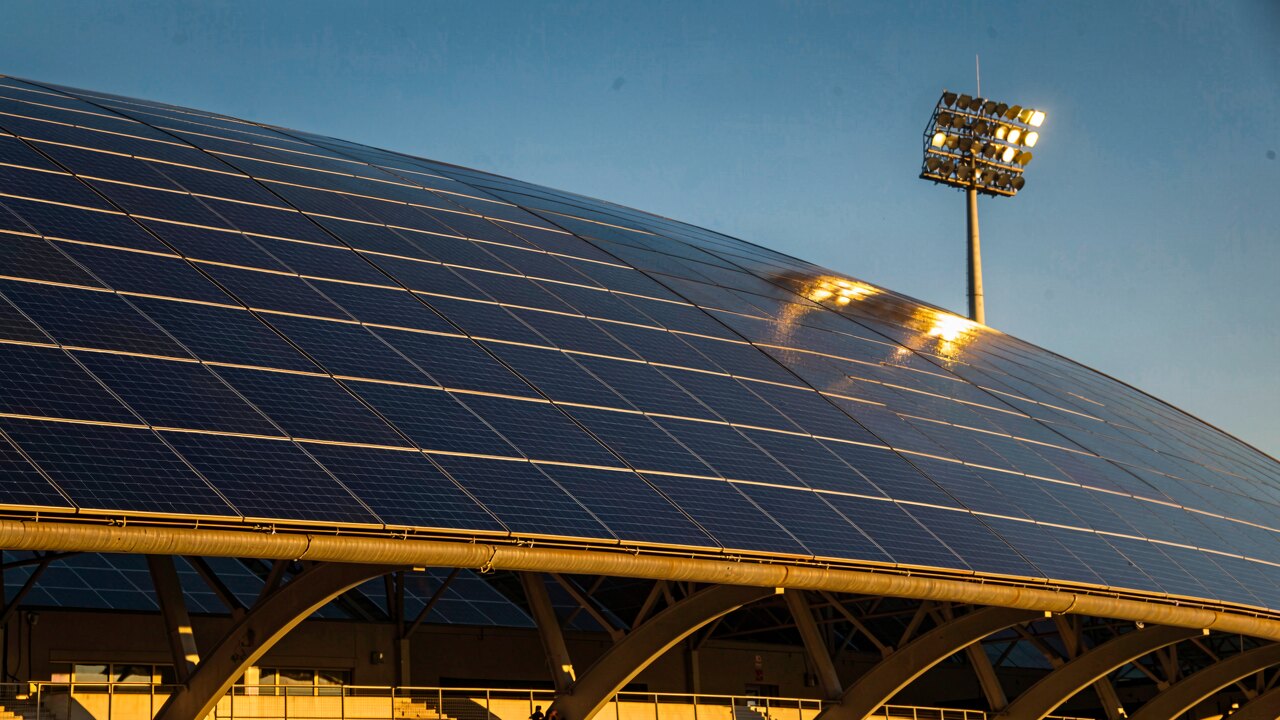
- Patriot Place solar area: In two expansion stages, solar carports and rooftop PV systems were installed over the outdoor areas. The first phase in 2010 was a 525 kW installation on seven building rooftops (Constellation Energy / Evergreen Solar), supplying approximately 30 percent of Patriot Place's electricity. In a second phase, NRG Energy expanded the system to approximately 1 megawatt total capacity — including a solar canopy over outdoor walkways. In total more than 3,000 modules are installed; the expected annual yield of the expansion installation is stated at approximately 1.1 million kWh (NRG operator statement).
- 2 MW Bloom Energy fuel cells (since 2020): The Kraft Group equipped the stadium site with Bloom Energy Servers — solid-oxide fuel cells with a total output of approximately 2 megawatts. According to Bloom Energy, the system covers approximately 50 percent of the stadium's electricity demand. The cells generate electricity without combustion through an electrochemical process and are configured as a microgrid — the stadium can continue operating disconnected from the public grid in the event of a fault. The expected CO₂ savings are stated at approximately 1,500 tonnes per year (Bloom Energy press release 2020).
- Demand response with Enel X: Since 2017 Gillette Stadium has participated in a demand-response programme with Enel X — meaning that during peak-load phases on the grid, consumption is deliberately reduced (HVAC, lighting, cooling in unoccupied areas). Since the programme began, according to Enel North America, more than 125,000 USD in demand-response remuneration has been earned.
- Renewable energy certificates (RECs): In the 2019 season and in the 2021 to 2023 seasons, the entire electricity supply was covered by RECs — operations were accounted as fully renewable.
- 50 EV charging points: JuiceBox Pro fast-chargers are available on site for visitors; the charging management is linked to the Enel X grid management system.
Context: The 1 MW solar installation generates approximately 1.1 million kWh per year — covering by industry benchmarks approximately 7 to 15 percent of a comparable annual demand (rough range; no published coverage ratio from the operator for the entire stadium). The more relevant lever is provided by the fuel cells: with approximately 2 MW continuous output they contribute considerably more than the PV — and do so regardless of sunshine hours and time of day.
A conventional battery storage system in the stationary sense is not documented for Gillette Stadium; the resilience function is fulfilled by the fuel cells in microgrid mode.
Stromfee Assessment
Gillette Stadium is an instructive example showing that the energy transition in a stadium does not always come via the roof. The pitch lies under open sky, the roof overhang is narrow — classic rooftop PV as in Atlanta or Seattle is absent. Instead, the operator combines solar on ancillary buildings, fuel cells as baseload generators and active demand response — three instruments that together constitute a serious energy strategy.
This is precisely the triangular logic that Stromfee also describes for industrial installations: own generation (solar), on-site continuous supply (here fuel cells, elsewhere combined heat and power) and flexible load management. Those who know all three levers and calculate with real market prices will find the most economical combination — for a stadium just as for a PV system with CHP and storage.
Transparency & sources: Capacity and opening date per Gillette Stadium / StadiumDB / Kraft Group (as of June 2026). Patriot Place solar data (525 kW / 1 MW / >3,000 modules / 1.1 million kWh/year): Constellation Energy press release 2010, NRG Energy / NEREJ, patriots.com. Bloom Energy fuel cells (2 MW, ~50 % demand, ~1,500 t CO₂/year): Bloom Energy press release July 2020. Demand-response remuneration (>125,000 USD since 2017): Enel North America Case Study. Pitch heating (~150,000 lf PEX): fansided.com / sheaconcrete.com. World Cup schedule: FIFA / gillettestadium.com (as of June 2026). Annual consumption and match-day load: industry benchmark per electricchoice.com / SEIA; no measured values for this arena. Battery storage: not documented in public sources — not assumed. Image shown is an AI illustration (FLUX·2), not a photograph of the stadium.
Have your installation checked?
Independent grid & drive analysis, direct marketing and metering concept — by HR Energiemanagement.
Get in touch →