Hard Rock Stadium Miami: Canopy Against the Heat — Energy Profile of a World Cup Quarterfinal Venue
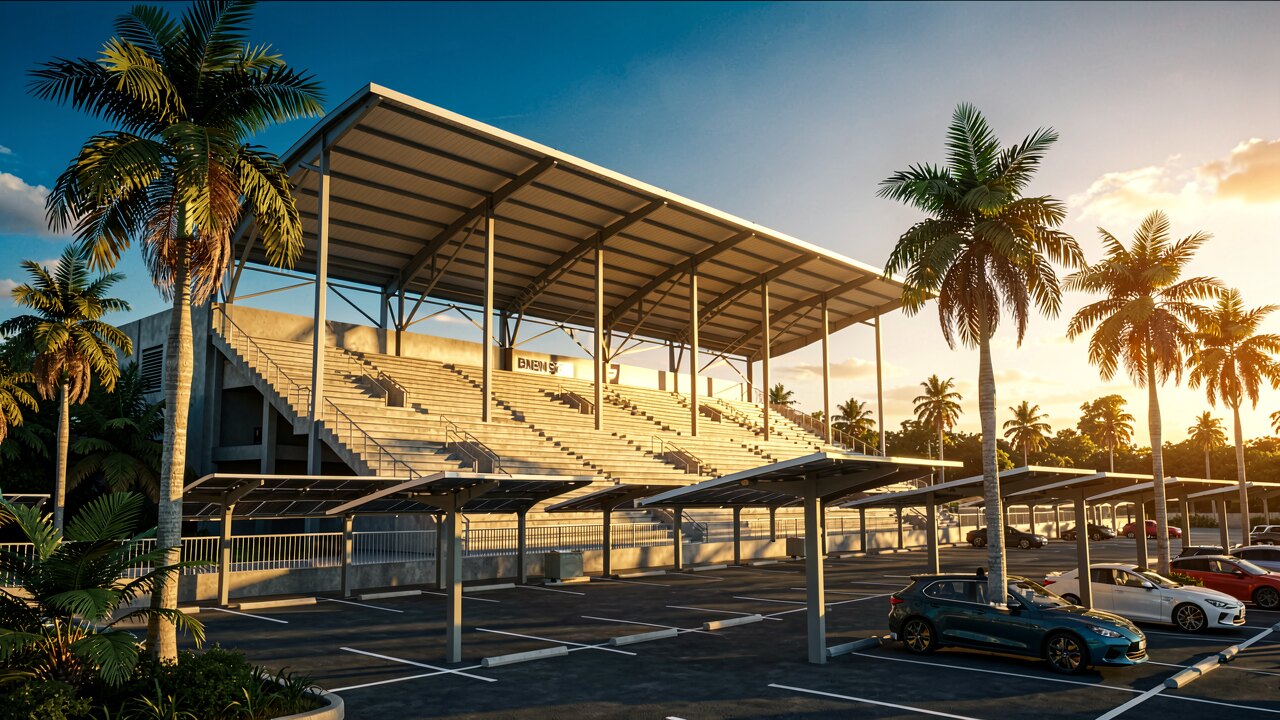
Miami Gardens, Florida, will host seven World Cup matches in 2026 — including a quarterfinal on July 11 and the third-place match on July 18. Hard Rock Stadium brings an unusual asset to the occasion: a vast, permanently open canopy roof that shields approximately 92 percent of spectators from sun and rain without spanning the pitch. At one of the hottest and most humid World Cup venues in the United States, this is not an aesthetic detail — it is an operational necessity that significantly shapes the arena's energy balance.
Architecture & Capacity
The stadium opened in 1987 and was most recently comprehensively renovated between 2015 and 2016 at a cost of approximately 500 million US dollars. The defining result of that modernisation is the open canopy roof: designed by architectural firm HOK and structurally realised by Thornton Tomasetti, the membrane roof is carried by eight massive reinforced-concrete super-columns. Sixteen groups of cable stays — comprising a total of 64 steel cables each up to 91 metres long — tension the structure. Approximately 8,900 square metres of ETFE cushions at the inner edge of the roof block direct sun and rain while still admitting daylight and air. The roof does not close over the pitch — the field remains exposed to the sky. The World Cup natural-grass surface (Bermuda grass, FIFA specification) can therefore operate without artificial growth lighting.
Seating capacity is approximately 65,000. The home team is the Miami Dolphins (NFL). The stadium also hosts the Miami Open (tennis) and the Formula 1 Miami Grand Prix, and has been the venue for six Super Bowls. During the 2026 World Cup the arena will carry the FIFA tournament name "Miami Stadium".
How Much Electricity the Stadium Needs
The operator has not publicly published precise annual consumption figures for Hard Rock Stadium. Industry surveys for US professional large stadiums of this class typically cite 7 to 15 million kWh per year; for a single match day (approximately 10 operating hours), comparable arenas are quoted at around 50,000 to 65,000 kWh — a rough industry benchmark, not a measured match-day figure for this arena.
What distinguishes Miami energetically from northern World Cup venues such as Seattle or Boston is above all the climate: Miami Gardens lies in a humid subtropical climate zone. In July temperatures regularly reach 32–35 °C with high humidity. The largest electricity loads in operation:
- Air conditioning (HVAC): Although the canopy roof leaves the pitch open — making full cooling of the entire arena technically impossible — the concourse level, suite levels and catering infrastructure for 65,000 visitors must be intensively air-conditioned. In Miami, cooling is likely to be the dominant load on a July match day. For covered southern arenas of this size, match-day cooling loads in the range of around 15 MWh are cited (industry figure, not a measurement for this arena).
- Floodlights (LED): The stadium has switched entirely to LED floodlights — according to operator statements this reduces energy consumption in the lighting segment by up to 75 percent compared with older metal-halide systems. For evening matches and television production the floodlights remain a noticeable load.
- Video displays: The stadium features large-format LED video walls for spectator information and broadcast production — a continuous consumer during match operations.
- Catering: Large kitchens, cold stores and dispensing infrastructure for approximately 65,000 people.
The canopy roof itself shades approximately 92 percent of the spectator stands. This reduces the direct heat input into the terraces and thereby indirectly lowers cooling demand compared with a fully open bowl under the Florida sun — an indirect efficiency gain that does not show up in any single consumption figure but is real.
Renewable Energy & Sustainability
Hard Rock Stadium received LEED Gold certification (US Green Building Council) following the 2015–16 renovation — according to the operator one of six NFL stadiums at Gold level or above. The sustainability strategy rests on several levers:
- LED retrofit: The complete switch to LED floodlights is, according to operator statements, the single largest energy-saving measure — with a stated reduction in lighting consumption of up to 75 percent.
- Waste avoidance and biogas recovery: The stadium operates liquid and biodigesters for organic kitchen waste; recovered cooking oil is processed into biofuel. The stadium is a member of the Green Sports Alliance.
- Water conservation: Waterless urinal systems and touchless sensor fittings are installed throughout the building.
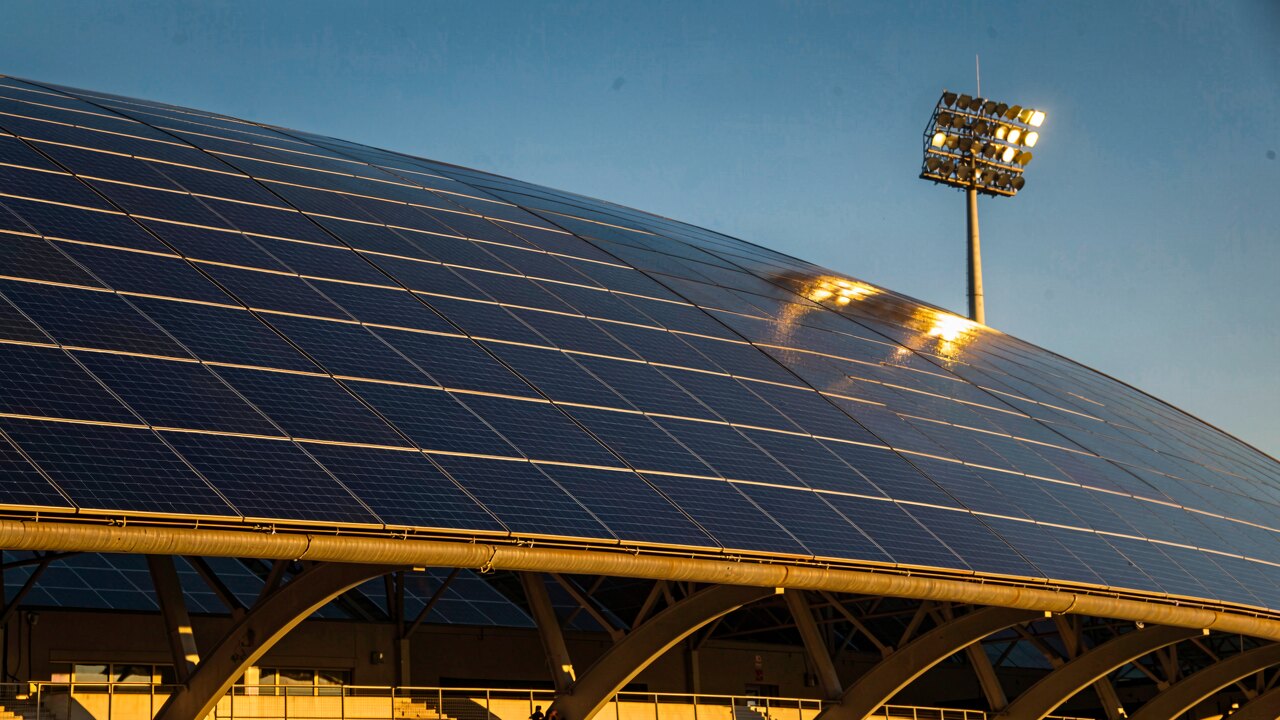
- Solar on the site: Public sources indicate that the Hard Rock Stadium site has solar carport structures in the parking areas. No verified capacity or module count from the operator is available; we therefore cite no figure. A dedicated rooftop photovoltaic installation on the canopy itself is not substantiated by available sources.
Context: The measures are real and go beyond cosmetic greenwashing. Measured against the solar flagship venues among the 2026 World Cup arenas — Atlanta (LEED Platinum, approximately 4,000 modules, over 1,600 MWh/year solar) or Seattle (approximately 3,750 modules, over 830 MWh/year) — the solar footprint of Hard Rock Stadium is considerably smaller. The focus here is on operational efficiency and waste avoidance rather than on-site electricity generation.
World Cup 2026 Role: Miami as Quarterfinal and Third-Place Venue
Miami Gardens will host seven matches of the 2026 World Cup: four group-stage games (June 15, 21, 24 and 27), a round-of-16 match (July 3), a quarterfinal on July 11 and the third-place match on July 18, 2026. This makes Miami one of the most important venues of the tournament — and the last World Cup host before the final is played on July 19 at MetLife Stadium in New Jersey. The subtropical July climate in Miami is likely to present some of the most demanding conditions of the entire tournament for players and spectators alike.
Stromfee Assessment
Hard Rock Stadium is an instructive example of what happens when a stadium addresses its climate challenge architecturally rather than mechanically: the canopy roof is not an air-conditioning system — it is passive shading that limits the cooling task for the spectator area from the outset. LED floodlights, biogas recovery and LEED Gold show that the operator takes the efficiency topic seriously. On the generation side, however, the stadium lags well behind solar frontrunners such as Atlanta or Seattle.
The same trade-off — passive protection (shading, insulation) versus active generation (solar, storage) — also arises for industrial operators and PV-system owners in Germany and beyond. Our freely accessible tools show what real exchange-price data and a storage system make of that equation for your own installation.
Transparency & sources: Capacity and opening year according to StadiumDB / hardrockstadium.com (as of June 2026). Roof architecture and renovation cost: AECOM / Thornton Tomasetti / HOK project descriptions; Ruby & Associates (structural data, cables/columns). ETFE area and shading ratio: operator statements per Thornton Tomasetti / Structure Magazine. LEED Gold certification and LED savings (up to 75 %): hardrockstadium.com / Eaton Lighting Case Study. Biogas recovery and waste avoidance: media.hardrockstadium.com/sustainability. World Cup schedule: FIFA / AOL Sports / miamigardens.com (as of June 2026). Solar carports: public source citation without verified capacity figure — no figure stated. Annual consumption and match-day load: industry benchmark per electricchoice.com / SEIA; no measured match-day values for this arena. Image shown is an AI illustration (FLUX·2), not a photograph of the stadium.
Have your installation checked?
Independent grid & drive analysis, direct marketing and metering concept — by HR Energiemanagement.
Get in touch →