Levi's Stadium Santa Clara: NFL Solar Pioneer as the 2026 World Cup Bay Area Venue
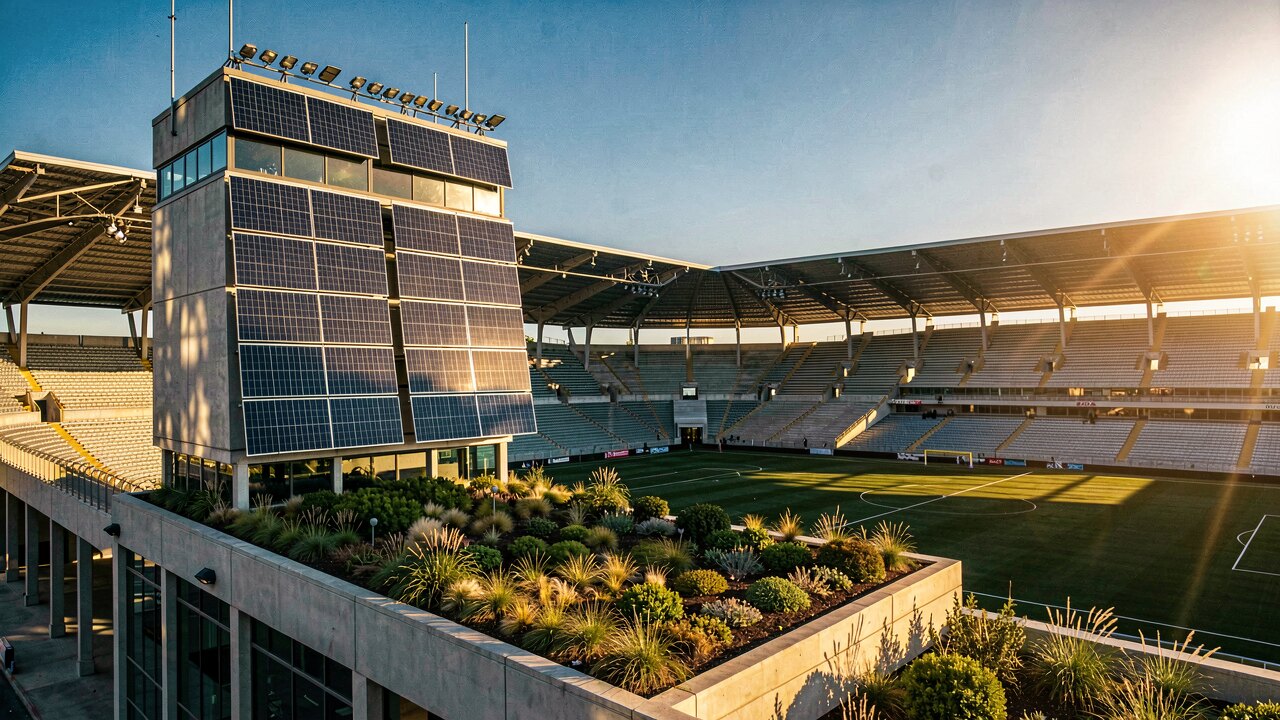
For the 2026 FIFA World Cup, Levi's Stadium in Santa Clara, California, carries the official FIFA host city name "San Francisco Bay Area Stadium." The sponsor branding must be fully covered for the tournament — a FIFA requirement to protect tournament sponsors. Six World Cup matches take place here: five group-stage games and one Round of 16 fixture. From an energy perspective, the arena is one of the more interesting of the 16 World Cup stadiums: it combines a documented solar installation, a green roof and a fuel cell under one roof — and was in 2014 the first professional football stadium in the USA to receive LEED Gold certification.
Architecture & Capacity
Levi's Stadium opened on July 17, 2014 and is the home of the San Francisco 49ers (NFL). Its standard configuration seats approximately 68,500 spectators; for major events such as Super Bowl LX (February 2026) or the World Cup, capacity can be expanded to up to approximately 75,000 seats. The arena cost approximately 1.3 billion US dollars to complete — one of the most expensive NFL builds of its time — and covers approximately 172,000 square metres of floor space. Architecturally the stadium consists of an open bowl with a distinctive five-storey Suite Tower on the west side, whose roof accommodates the main sections of the solar installation as well as the green roof.
What the stadium consumes in electricity
Concrete annual figures for total consumption at Levi's Stadium are not publicly documented. For context: industry surveys of US professional stadiums cite typical figures for comparable NFL arenas of 7 to 15 million kWh per year — depending on air-conditioning effort, number of events and roof configuration. On a match day, peak load in this class can reach 1 to 2 MW; the operator's own figures state specifically approximately 1.5 MW peak load on match days.
The four classic primary consumers of an NFL stadium are all present here: LED floodlighting, air conditioning (Northern California has hot summers — September match days can be warm), video screens and catering with commercial kitchens and refrigeration. Levi's Stadium does not have a fully retractable roof, which significantly reduces the air-conditioning burden compared with fully climate-controlled arenas such as NRG Stadium in Houston. The conversion to LED floodlighting has — as throughout the NFL — drastically reduced lighting consumption compared with earlier metal-halide systems.
For the World Cup, additional temporary loads apply: extra lighting for TV broadcasts at the highest quality level, reinforced sound systems and the increased operational effort from FIFA tournament infrastructure. Exact match-day figures for the World Cup fixtures are not available.
Renewable Energy & Sustainability
The sustainability concept at Levi's Stadium is documented and has been independently certified on multiple occasions — it goes beyond a pure marketing claim.
Solar installation (approx. 375 kW peak capacity): A total of 1,186 solar panels are installed at two locations: on the roof of the five-storey Suite Tower and on three covered pedestrian bridges connecting the main parking areas to the entrance. The bridges are themselves revenue-generating installations — pedestrians literally walk under a solar array. The operator states that the installation generates, on an annual calculation basis, as much electricity as is consumed during the 49ers' regular home games. Figures in the range of several hundred thousand kWh per year are cited; the ranges quoted in various sources (approximately 375,000 to roughly 850,000 kWh/year) point to differing measurement methods or system changes — an official, current figure is not available to us.
400 kW fuel cell: Alongside the solar installation, the stadium operates a fuel cell with approximately 400 kW capacity that serves as a continuous baseload source and feeds in at night and during overcast conditions. Together with the PV it forms a hybrid self-supply concept that breaks from the NFL's usual complete grid dependence.
Green roof (approx. 2,500 m²): The Suite Tower roof carries an extensive green roof covering approximately 27,000 square feet (approx. 2,500 m²) of planted surface. Drought-resistant plant species native to California were used. The green roof serves three functions simultaneously: it insulates the building (the operator cites up to 20% savings in heating and cooling costs for the area below), it buffers and filters rainwater, and it extends the service life of the underlying roof membrane through UV protection.
LEED Gold — twice: At opening in 2014, the stadium became the first NFL stadium in the USA to receive LEED Gold certification for new construction. In 2016 a second LEED Gold award followed, this time for Operations and Maintenance of an existing building — evidence that the sustainability measures are maintained during ongoing operations and were not only measurable at construction completion.
Water recycling: Levi's Stadium was in 2014 the first stadium in California to use recycled water for toilet flushing and irrigation — a significant resource saving during droughts that reduces the overall operational footprint.
Electric mobility: Twelve EV charging points are available on the stadium site; in the immediate vicinity the city of Santa Clara operates what was at the time one of California's largest public EV charging facilities, with approximately 49 charging points in a six-storey car park — itself equipped with an approximately 370 kW solar installation and battery storage.
Stromfee Analysis
Levi's Stadium shows what is possible when sustainability is integrated into the construction process from the outset rather than retrofitted: solar on the roof and on infrastructure (bridges), green roof as a multi-function element, fuel cell as a weather-independent supplement. Nevertheless the stadium remains a net large-scale consumer — the solar installation covers the home matches in calculation terms, but not the full annual demand of operations including concerts, events and permanent infrastructure.
The same underlying logic — solar generates, storage or fuel cell buffers, the grid fills the rest — applies to every German commercial enterprise with a PV installation. How high the real self-consumption share is, and what a battery storage system or the room for manoeuvre under Section 51 of the German Renewable Energy Act (negative prices) would mean in concrete terms, can be calculated with just a few inputs:
Transparency & Sources: Capacity and opening data from Levi's Stadium / Santa Clara Stadium Authority. LEED data from official operator press releases and USGBC (2014, 2016). Solar data (panel count 1,186, peak capacity approx. 375 kW, fuel cell approx. 400 kW) from operator statements and NRG press release. Green roof area from Greenroofs.com project documentation. Annual energy figures for the solar installation vary by source and measurement method; no independent measurement carried out. Industry ranges for NFL stadiums (7–15 million kWh/year, peak load 1–2 MW) from electricchoice.com / SEIA industry surveys — no match-day measurements for World Cup fixtures. FIFA fixture schedule and venue name "San Francisco Bay Area Stadium" from FIFA / SFBAYAREAFWC26.COM (as of June 2026). The hero image is an AI illustration (FLUX·2), not a photograph of the real stadium.
Have your plant assessed?
Independent grid & drive analysis, direct marketing and metering concept — from HR Energiemanagement.
Get in touch →