NRG Stadium Houston: How a Climate Machine Handles Seven World Cup Matches
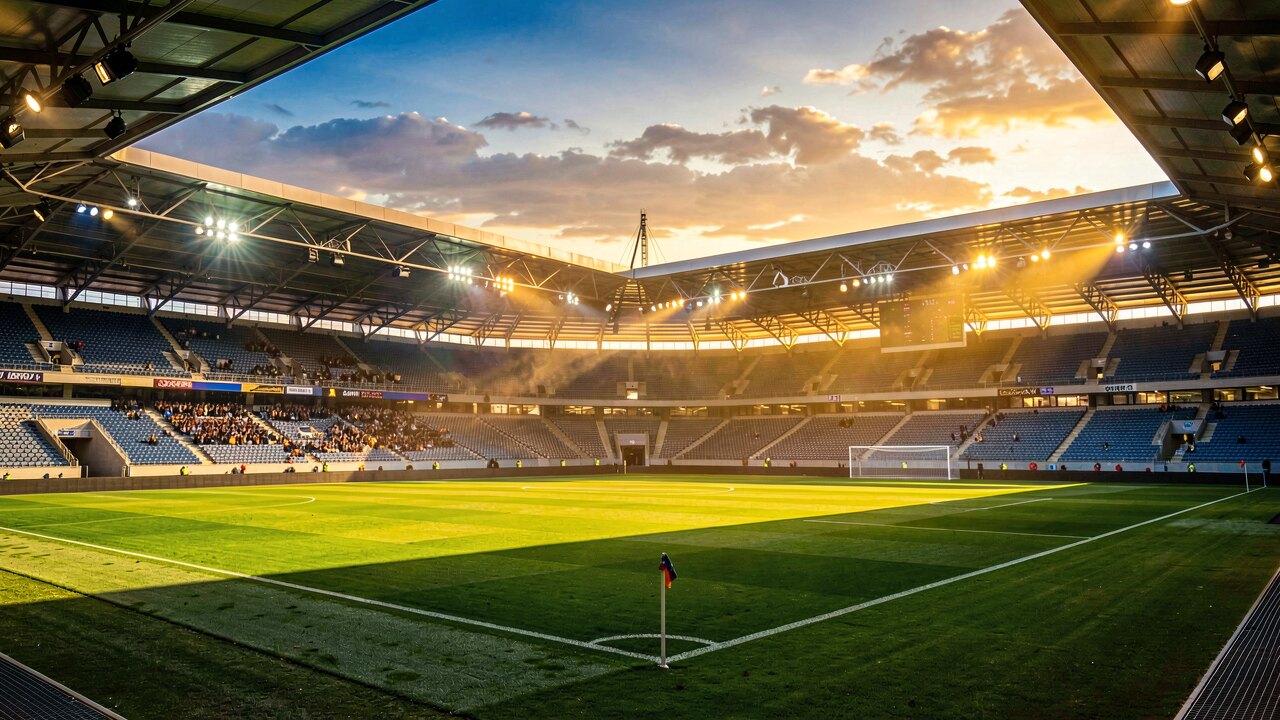
The FIFA Football World Cup has been under way since June 11, 2026 — and Houston, Texas, is one of the hottest host venues in history, literally and figuratively. NRG Stadium, officially named "Houston Stadium" for the duration of the tournament, hosts seven matches: five in the group stage, a Round of 32 fixture and a Round of 16 match on July 4. In a city where summer routinely brings temperatures above 34 °C and 80 percent humidity, the energy demand of a fully packed stadium is not an abstract figure — it is a serious infrastructure challenge.
Architecture & Capacity
NRG Stadium opened in August 2002 at a cost of approximately 352 million US dollars. It is the first NFL stadium in the world with a retractable roof — a pioneer whose design was also driven by climatic necessity: an open stadium would have been barely tolerable in Houston's summer heat. The roof consists of a translucent PTFE membrane (polytetrafluoroethylene), which allows diffuse daylight through and opens or closes in approximately seven minutes. The regular home of the Houston Texans (NFL) and the largest annual fair in the world — the Houston Livestock Show and Rodeo — share the building throughout the rest of the year.
What the stadium consumes in electricity
Reliable match-day measurements for individual World Cup fixtures are not available. What can be derived from industry surveys and operator data for comparable US professional stadiums:
- Annual total consumption NRG Park (all four halls of the complex): estimates from the trade press cite approximately 25–30 million kWh per year for the entire complex; for the stadium alone, approximately 15 million kWh/year is cited as the industry norm.
- Single match day: for an NFL home game or major event, industry-wide order-of-magnitude figures of 50,000–65,000 kWh apply — roughly the equivalent of 50–65 American households' monthly consumption.
- Peak load during the match: up to approximately 10 MW is cited for comparable enclosed arenas of this scale — roughly equivalent to simultaneously powering a small industrial estate.
These figures come from industry aggregates and operator statements; they are order-of-magnitude estimates, not verified measurements for individual World Cup matches.
By far the largest single consumer is air conditioning. When 72,000 people sit inside an enclosed PTFE-membrane shell with 34 °C and high humidity outside, the HVAC system must maintain approximately 1.9 million square feet (approx. 177,000 m²) at a tolerable temperature. Industry estimates for such systems put HVAC at 40–50% of total match-day electricity. The stadium uses multiple chiller plants; the modernisation programme launched in 2023 (Johnson Controls, 20-year contract) added high-efficiency chillers and variable frequency drives on ventilation units.
Floodlighting accounts for another substantial share. Since 2014, NRG Stadium has been the first professional football stadium in the USA with LED floodlighting on the playing surface — 456 LED spotlights replaced the old metal-halide lamps and, according to operator data, reduced lighting consumption by approximately 65 percent. Opening or closing the roof itself requires only approximately 50–60 kWh — a marginal item compared with the stadium's remaining consumption.
Renewable Energy & Sustainability
NRG Stadium was also in 2014 the first professional football stadium in Texas with a solar installation: four solar carport canopies ("NRG Haven Solar Canopies") on the site together carry approximately 700 panels with roughly 221 kW peak capacity. Compared to other World Cup stadiums — such as Mercedes-Benz Stadium in Atlanta (approximately 4,000 panels, over 1,600 MWh/year) or Lumen Field in Seattle (3,750 panels) — this is a modest installation. It represents a small fraction of the complex's total consumption.
More significant is the efficiency programme launched in 2023 together with Johnson Controls: a 20-year contract that, through HVAC upgrades, building automation, high-efficiency chillers and water efficiency measures, promises estimated savings of more than 54 million US dollars and an annual CO₂ reduction of over 241,000 tonnes. According to the operator, the programme is fully financed from the savings achieved. Independent verification of these projections was not available at the time of writing — these are contract targets, not measured results.
More extensive self-generation via rooftop PV, as implemented at Atlanta or Seattle, does not exist at NRG Stadium. Large parts of the roof are the moveable PTFE membrane, which is unsuitable for panels; the fixed edge zones of the roof do not yet carry any PV installation.
Stromfee Analysis
NRG Stadium illustrates exactly what happens when a high-load building is operated in an extreme climate: air conditioning dominates the energy balance so strongly that even an ambitious LED programme and a pioneering solar installation only provide a small offset. Structurally this is no different from a large German industrial facility or cold store — except that here the load arrives in bursts: seven hours at full capacity, then silence.
Precisely this logic — peak load, self-generation and storage — is what we analyse for plants of any size. What a battery storage system does to a fluctuating grid-draw profile, and what Section 51 of the German Renewable Energy Act means for your PV plant in concrete terms, is shown by our freely accessible tool:
Transparency & Sources: Capacity and opening year from Wikipedia/StadiumDB (as of June 2026). World Cup fixture schedule from FIFA (houston.fifa.com). Consumption figures from industry aggregates (electricchoice.com, operator data); these are order-of-magnitude estimates, not verified match-day measurements. LED retrofit and solar installation 2014: NRG Energy press release, Green Sports Alliance. Johnson Controls programme 2023: Johnson Controls/Harris County press release. The images shown are AI illustrations (FLUX·2), not photographs of the real stadium.
Have your plant assessed?
Independent grid & drive analysis, direct marketing and metering concept — from HR Energiemanagement.
Get in touch →