Lumen Field Seattle: Stadium Power and Solar — What Seattle's World Cup Arena Really Consumes
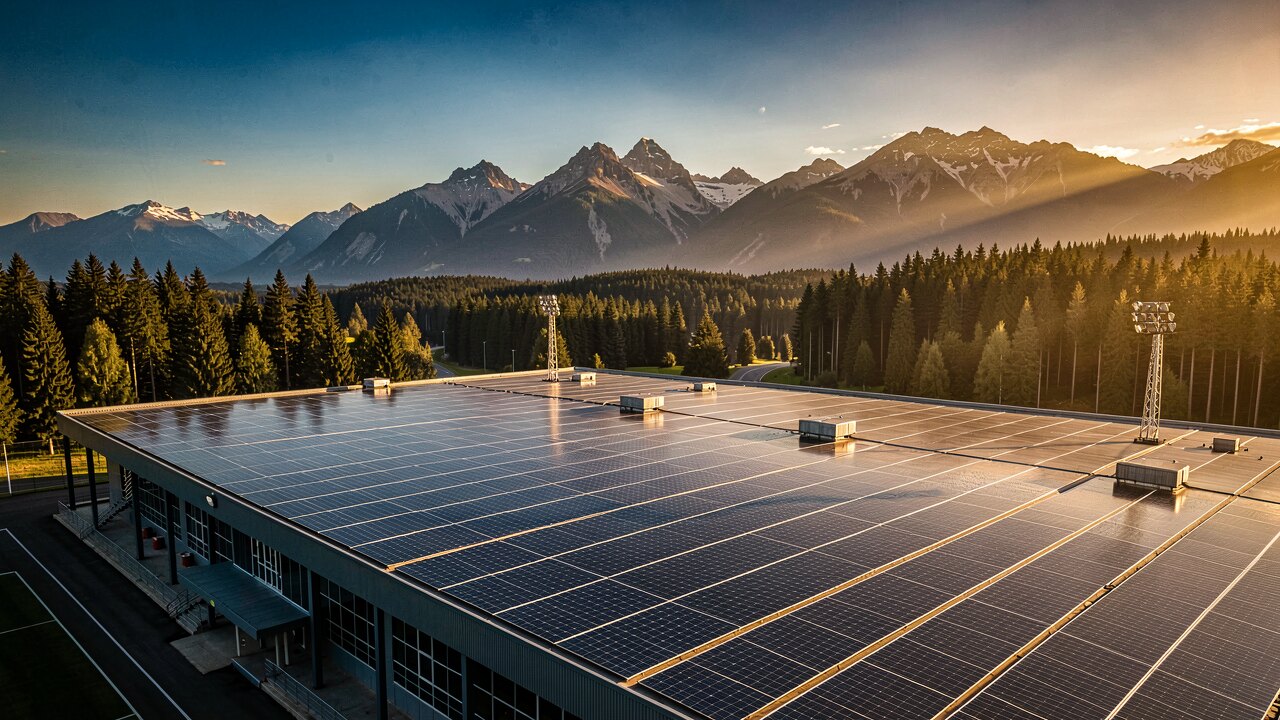
Six World Cup matches, including a round of 16: Lumen Field in Seattle is one of the northwesternmost World Cup arenas in the world — and carries on the roof of its attached Event Center one of the largest stadium solar installations in the USA. A look at the numbers, construction history and the energy character of the installation.
Architecture & Capacity
The stadium opened in July 2002 — initially under the plain name Seahawks Stadium, then Qwest Field (2004), CenturyLink Field (2011) and finally since November 2020 Lumen Field, named after telecommunications company Lumen Technologies. For the 2026 Football World Cup, FIFA uses the neutral designation "Seattle Stadium".
The standard NFL capacity is approximately 68,740 seats; for the World Cup it has been adjusted to around 65,000, as is common for many American football stadiums in order to accommodate the tighter football-stand geometry. Home clubs are the Seattle Seahawks (NFL) and the Seattle Sounders FC (MLS) — making Lumen Field one of the few arenas that hosts both professional football and professional soccer at the top level.
Characteristic is the partially open roof: the canopy protects most seats from Seattle's frequent rain while still allowing natural grass to grow and preventing the continuous air-conditioning operation typical of enclosed dome stadiums. Surrounding the main stadium is the Lumen Field Event Center — a multi-purpose hall whose roof carries the solar installation.
What the Stadium Consumes in Electricity
Lumen Field is a partially roofed open-air stadium in the temperate maritime climate of the Pacific Northwest. That strongly shapes the consumption profile: unlike fully air-conditioned dome stadiums in Texas or Arizona, continuous cooling operation is largely absent here. The dominant consumers are:
- Floodlighting (LED): The stadium has converted to LED. LED floodlighting requires significantly less energy than older halogen metal-halide systems — and can be switched on and off in seconds. For match days with fully lit playing surfaces, substantial loads remain nonetheless.
- Food & beverage / catering kitchens: Cooking, refrigeration and dishwashing for tens of thousands of visitors simultaneously creates short, intense load peaks, especially at half-time.
- Video boards & scoreboards: Large-format LED screens inside the stadium are continuously active during a match.
- Infrastructure & security: Concourse lighting, escalators, lifts, ventilation of basement areas.
- Pitch heating: A pitch heating system is installed for winter NFL games — largely irrelevant for the summer World Cup 2026.
As a benchmark for US professional stadiums of this size, industry surveys cite 7 to 15 million kWh per year and peak loads of up to 10 MW during an evening match. Verified individual figures for Lumen Field are not publicly available; in keeping with Seattle's climate, heating and cooling likely weigh considerably less than at the Texan or Floridian competition.
Renewable Energy & Sustainability
The most widely visible sustainability element is the solar installation on the Event Center roof: 3,750 panels cover approximately 2.5 acres (about 1 hectare) of roof area and generate, according to operator figures, more than 830,000 kWh (830 MWh) per year. That corresponds to roughly 15% of stadium consumption, or the annual electricity use of around 90 Seattle households. Surplus power during the sun-rich summer months is fed into the public grid.
Together with an energy-efficient "Cool Roof" (a light, heat-reflective roofing membrane) and further efficiency measures, the operators have recorded an annual reduction in energy costs of around 21% and a reduction in the CO₂ footprint of more than 1,300 tonnes per year (operator figure, not externally audited).
In waste management, Lumen Field is a leader in the NFL: the stadium holds the TRUE Gold certification from Green Business Certification Inc. (GBCI) — at that time only the second NFL stadium to receive this award. To earn the certification, a waste diversion rate of 93% had to be demonstrated over a full year, meaning more than 6 million pounds of waste diverted from landfill. For the 2026 World Cup, Lumen Field has announced it aims to achieve a zero-waste event for all six matches.
Seattle draws its grid electricity through Seattle City Light — one of the few large US municipal utilities that sources the majority of its power from hydroelectricity and is nearly carbon-free on a long-term average. This weakens the leverage of decentralised stadium PV from a CO₂ perspective, but makes the installation still worthwhile as a load management instrument and grid-relief signal.
Stromfee Assessment
Lumen Field demonstrates an approach that is also relevant beyond professional sport: self-supply through rooftop PV, consumption optimisation (LED, Cool Roof) and consistent waste management as a unit. The 830 MWh/year across roughly one hectare corresponds to a specific yield of about 830 kWh/kWp — plausible for Seattle's overcast climate (compared with well over 1,000 kWh/kWp in southern Germany). For commercial operators in Germany with similar roof area and more favourable irradiation, yields would be higher.
Anyone who wants to know, for their own PV plant, how negative prices, §51 EEG and a potential storage system affect revenue will find a quick entry point with Stromfee:
Transparency & Sources: Capacity and schedule information per FIFA/LumenField.com/StadiumDB (as of June 2026). Solar data (3,750 panels, >830 MWh/year, 2.5 acres, ~15% coverage, 1,300 t CO₂ reduction, 21% cost reduction) from operator information (thebusinessdownload.com, seahawks.com, 2030districts.org). TRUE Gold certification: Seahawks.com press release. Consumption benchmarks for US professional stadiums: electricchoice.com, EnergySage. Non-publicly-audited operator figures are to be understood as such. The image shown is an AI illustration (FLUX·2), not a photograph of the real stadium.
Get your plant assessed?
Independent grid & drive analysis, direct marketing and metering concept — by HR Energiemanagement.
Get in touch →